June, 2020.
A walk around Lake Quigg
This blog post has quite a few photos. I took more than 240 photos on this walk, but don’t worry, I’m sharing only 26 of them here. It was a wonderful walk and Lake Quigg is a beautiful lake.
I awoke on this first peaceful morning of this camping trip, got dressed, ate breakfast, tidied the trailer, and stepped outside. Oh my, the lake and the trees were beautiful, and the day was absolutely gorgeous. (Remember you can enlarge photos by clicking on them.)

Clear across the lake, if you look closely, you can see a bridge over there on the left side. I knew there was a trail that went at least part way around the lake, but I didn’t know how far the trail went. The trail had to go at least to the bridge, yes?
And then I zoomed in to the bridge with my camera …

Ah ha! A mother and small child on the bridge. If they can do it, I can do it. Ok, I’m going!
First, I searched for and found a sign on the campground property that gave me more information about the path around the lake, and yes the path did go completely around the lake.

The red arrow points to my campsite. The yellow arrow points to the path and shows the direction I took around the lake. My walk (including a few side excursions) was a little over two miles long and took almost two hours.
The bridge at the left side of the map above (same bridge as is in the photo above) crosses over a waterway that feeds the lake from the Chehalis River. We’re close enough to the saltwater of the Pacific Ocean here, that the ocean tide causes the river level and the lake level to rise and fall with the fluctuation in the height of the tide. As the river water backs up with an incoming tide, then the river water flows “uphill” into Lake Quigg. There always seemed to be plenty of water in Lake Quigg, even at low tide, but the water level rose considerably when the tide was high.
I gathered my camera, a spare camera battery, my hiking pack of necessities, and off I went on my walk.


It was luscious.
There are two fishing docks on the lake. Both are wheelchair accessible.


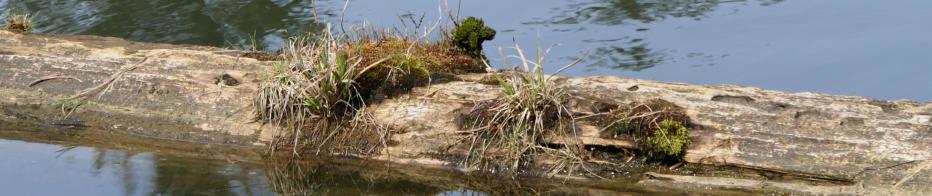
I was enchanted by the logs that were fastened to the dock and to the shore, and that held the dock in place.


Eventually, I looked up around me, at my surroundings, and realized I could see the campground from this fishing dock … way off there in the distance, on the right (photo below).

And then I realized I could see Towhee the Trailer way off there in the distance.

Towhee the Trailer is at the very right hand side of the photo above.
I left that fishing dock, got back on the trail, and headed to the bridge that crossed over the waterway inlet to the lake.
I had no more than touched foot to the bridge when I saw a River Dolphin! What a fluke of good luck! I managed to catch a photo of it leaping out of the water, just past the large log, in the photo below.

I adjusted my camera to zoom in and maybe catch a photo when it next lept out of the water.
Oh, but wait a minute. Oh, hmmm. Sigh, I have led you astray again. That “river dolphin” never moved. It just stayed there in the air. Ha, the joke’s on me … that “river dolphin” was a tree trunk. But I bet you believed me for just a minute there, didn’t you? 🙂 It sure did look like a river dolphin to me!

I stayed on the bridge for several minutes, hoping to see a river otter or an osprey. Sightings of both had been reported recently. No luck there, so on I went around the lake.


It was springtime, and lots of plants were just now blossoming out.


There were two or three places along the path where one could sit and rest a spell and enjoy the view across the lake.


As I walked further, I noticed several streamlets or rivulets burbling along under the greenery, flowing into the lake.

By far, most of the trees were evergreen, but there were a good number of very handsome deciduous trees too.

Here (below) are two short videos I took as I walked along. The first simply shows the flora and the path and the lovely day with a variety of bird song in the background.
Turn your sound on, and turn the volume up.
Video #1
Now listen closely to this second video (below) and tell me please what bird we hear. I loved the first sound it made, just a sweet little “chirp”, “chirp”, “chirp”, but then the call changed … the second, higher pitched call (though still just a single “chirp”) seemed more like a danger signal. Maybe that bird saw me and was sending out a warning. “Watch out! This woman walking here doesn’t know a river dolphin from a tree stump! Watch out!”
Video #2
Do you know what bird that is?
Eventually, I completed my circumnavigation of the lake and then headed back onto the very nicely maintained grounds of the campground.

I walked past and explored two small boat ramps, the tent camping area, a children’s playground, a large and well-appointed toilet/shower building, and the campground office building. All of that was nice, but what struck me most was the precisely positioned guard of the entire campground (below), perched atop one of the fence posts just inside the entrance to the campground.


Maybe THIS was the bird that sent out that warning in the video above. I wouldn’t be at all surprised.